Long before modern engineering formulas, modeling software, and climate-control systems existed, Indian builders constructed structures that could handle complex issues. Methods such as geometric discipline, material intelligence, and careful observation allowed them to do this. Two of the most remarkable examples of this approach are the stepwells of Patan in Gujarat and the ancient city of Hampi in modern-day Karnataka. The finest architectural logic, in which science, beauty, and social life all came together, can be seen in each of these places, despite their differences in function and location.
In addition to its practical use as a weight bearer, the sculptures at Hampi demonstrate how stone might react to ritual, music, and movement. In extremely hot or cold climates, Patan's stepwells demonstrate how passive design can manage water, temperature, and human comfort. Taken as a whole, these locations serve as living textbooks on the engineering mindset of antiquity.
This study views them as functional systems rather than as historical artifacts.
The Origins of Ancient Design in Material Intelligence
The builders of yesteryear had a deep understanding of the resources at their disposal. The majority of Hampi's rocks are granite. It stands sturdy, thick, and weatherproof. The builders capitalized on its assets rather than attempting to address its shortcomings. One option was to carve the structure directly into the rock, while another was to use precisely cut blocks that did not require mortar.
Sandstone and other sedimentary rocks were beloved by the Patan people. These stones retain their pliability even when subjected to extreme pressure, making them ideal for intricate carvings. They are ideal for subterranean structures that require constant cooling due to their high thermal mass.
In all domains, aesthetic considerations were secondary when selecting materials. The weather, accessibility, expected behavior of the structure, and expected lifespan were all factors in the deliberate decision-making process.
The Designed Soundscape of Hampi
The term "ruined city" is often used to describe Hampi, yet it is inaccurate. You could hear them, and you could see a few of its sections as well. Among its many intriguing features are the musical pillars. When gently struck, these stone columns emit a variety of noises.
There is substance to these pillars. They have a sturdy granite construction. On the other hand, they produce audible and persistent noises when tapped. There is some significance to this.
Musical Foundations in Science
Each pillar serves as an adjustable beam from a structural perspective. It trembles in response to impact. The length, form, stiffness, and top and bottom fastening methods of the pillar determine the frequency of the vibration.
A high elastic modulus allows vibrations to pass through granite without much damping. Modifications to the mass distribution along the pillar caused by carved elements like reliefs, fluting, and stepped transitions cause subtle shifts in vibrational modes.
It is crucial to note the connection at the base. Vibrations felt by a pillar not anchored to a big stone floor are different from those felt by a pillar that is. To alter these confines, ancient builders employed joinery and stone seats.
The final product is a stone-based tonal system with a series of differingly tuned pillars. There is some order to the pitches. Their harmonic patterns are well-known.
Buildings as Instruments
It was intended to set up melodic pillars in massive mandapas. These halls have a louder sound. Their pillar spacing, floor weight, and roof design all influence the way sound travels through and eventually leaves a building.
Because of its design, the hall amplifies sound by reflecting it off the surrounding stone walls. As a result, a single column of vibration becomes a cosmic sound event.
Locations like these were likely used for ceremonial music, dance, and ceremonies. The building was more than a stage; it became an integral element of the performances.
This demonstrates an in-depth familiarity with acoustics acquired via practical experience and experimentation rather than theoretical analysis and equation writing.
Designing for perceptions outside of sight
The aesthetics are highly valued in many examples of modern architecture. As we can see in Hampi, ancient designs engaged all of our senses. The design placed a premium on movement, shadow, temperature, and sound.
The acoustics, lighting, and stone textures of Hampi evolve as you make your way through its pillared halls. The way we move and behave during rituals is dictated by these sensory cues.
Instead of focusing on abstract shapes, this approach brings architecture closer to people's perceptions.
Stepwells as Eco-Friendly Machines
The stepwells of Patan examine weather and survival, although the songs and rituals of Hampi focus on the opposite. Not only did these structures provide a cool location to escape the heat, but they also served to gather, store, and chill water.
There is more to a stepwell than meets the eye. A vertical environmental system is what it is.
Stepwell Operation
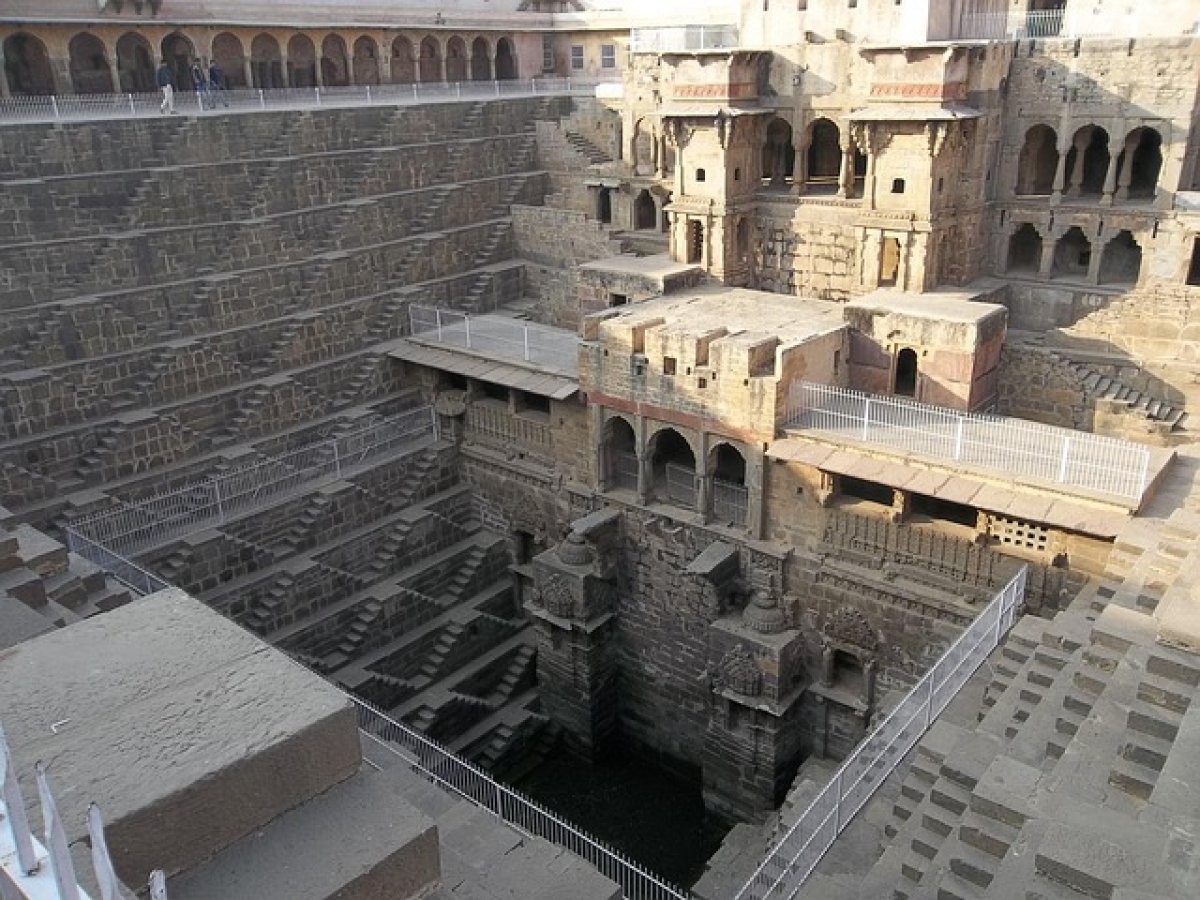
The stepwell is a network of landings, galleries, and terraces that descends into the earth. Located at the base is the water storage tank. Several stories of gloomy structures rise above it.
The temperature remains constant at this depth. When compared to surface temperatures, changes in subsurface temperatures are negligible. This keeps the air in the stepwell cooler even when the weather outside is scorching.
Experiment on Passive Cooling Theory
Cooling stepwells is the result of a number of interrelated processes.
Lower layers of the atmosphere contain cooler air because it is denser. Near the surface, warm air rises and then descends again. This allows for the gentle circulation of air without the need for mechanical assistance.
With the help of the air and stone around it, the water at the bottom slowly evaporates. Further cooling occurs as a result of evaporation.
In its own right, the stone functions as a thermal battery. It takes in cold air at night and progressively releases it throughout the day.
A microclimate, formed by the interplay of these activities, can be significantly cooler than its surrounding environment.
Mastering the Elements using Geometric Means
Stepwells provide a practical purpose beyond aesthetics. The structure's stability, airflow, or shade are all enhanced by each landing, overhang, and recess.
Air moves more quickly via narrow shafts. Because wide galleries slow it down, cooling may spread more evenly. Dangling balconies prevent sunlight from reaching lower floors.
Although repetition creates rhythm, it sometimes leads to things becoming too identical. If one part of the world gets too hot, the others nearby will cool off.
Hundreds of years ahead of its time, this structure adjusts to the weather.
The control of water and the logic of structures
Also, stepwells are water experts. The well is emptied of precipitation by means of channels and spillways. Sediment settles in various spots before it reaches the main reservoir.
As they descend, the walls thicken to resist the soil's increasing strain. Stress concentrations are dispersed thanks to the load routes' verticality and continuity.
The stepped shape facilitates inspection and repair. Everything from holes to leaks to garbage is plainly visible and easy to remove.
The Structure of Society Beneath
Stepwells served more than one purpose. They served as meeting spots. In order to escape the heat, people gathered to drink, rest, pray, and get supplies.
Markets sprang up in the shadows of shaded landings. Long, winding halls that descended used as locations for rituals. Behavior was inadvertently shaped by architecture.
People utilized it frequently because of the social cohesion, which ensured that it was maintained. Because of its daily importance, infrastructure persisted.
Distinct Engineering Worldviews
Engineers value diverse things, as demonstrated by Hampi and Patan.
Ceremonial fidelity, auditory precision, and spatial symbolism are the three pillars upon which Hampi rests. Being eco-friendly, comfy, and adaptable are the tenets of Patan.
However, they share a foundational premise: being forthright about materials, being explicit about forms, and doing experiments in the actual world.
Neither of these building kinds is particularly complex. Every component serves multiple purposes.
Maintenance and Fragility
The maintenance of such structures is technically challenging. Problems might arise from weathering, vegetation, changes in the water table, and pedestrians.
Very flimsy foundations for music. The way things vibrate is altered by microcracks. Hitting too hard can spoil the tune for good.
Both structural damage and groundwater contamination pose threats to stepwells. The way water drains can be affected by changes in the surrounding land use.
The behavior of the original materials must be respected during conservation. Typically, more harm than good comes from modern medicines that fail to consider these systems.
Architectural Lessons for the Modern Era
These ancient structures force us to reevaluate our assumptions.
Their results prove that passive systems are superior to active ones in specific scenarios. Their findings prove that one can deliberately create sensory experiences.
Also, they've shown that they can recover. Many of these structures have functioned mostly independently for more than 500 years.
Most modern structures don't even last half that long.
An Outline for Three Days of Pictures
The goal of this photographic map is to highlight the atmospheric variety as well as the engineering rationale behind it.
First Day: Stone and Sound at Hampi
Gather low-angle light on granite reliefs by starting at dawn. The carving's depth and tool marks become more apparent in the morning light.
Gather photographs of the pillar bases, capitals, and connections during the middle of the morning. Pay attention to geometry rather than ornamentation.
Document the spatial sequences, or the opening and closing of the halls, during the afternoon. Document the patterns of shadows on stone floors by taking photographs.
Once the sun sets, frame the pillars' shadows against the bright sky. Night photography allows one to observe the alignment of stars with temple axis.
The Second Day: Hampi and the Landscape Integration
Take note of the building's relationship to the surrounding landscape. Photograph the riverbanks, boulder bases, and vantage points from above.
Capture extended shots of clusters of valley temples. When referring to size, use either humans or animals.
Paths for document circulation, which include hallways, patios, and stairs.
Third Day: Patan—Decline and Depth
Photograph the stepwell's mouth from above, utilizing it as a geometric backdrop.
Go down slowly and capture photos of repeating patterns. Emphasize depth using vertical compositions.
Capture varying temperatures, such as haze, water reflections, and shaded stone textures, in your photographs.
Conclude with panoramic views taken from lower galleries, gazing upward, to demonstrate the passage of light through several layers.
Letters of Ethics
Photographs taken there should not detract from its beauty. Avoid handling delicate or easily broken carvings. You shouldn't randomly attack pillars.
Avoid using artificial lighting in confined spaces. Pay attention to the regulations of admission.
Instead of taking advantage of, documentation need to educate.
Reasons why certain structures carry significance
Neither Patan nor Hampi are the ruins of an extinct civilization. Intelligent design doesn't necessitate state-of-the-art technology, but rather meticulous study and reverence for the laws of nature, as these examples show.
Architecture may be precise without being rigid, expressive without being wasteful, and beautiful without sacrificing functionality; these examples demonstrate this.
These ancient feats of engineering offer us lessons that are relevant now, in an era of climate change and energy scarcity.
In conclusion
Penetration of stone by sound is possible. The air can be cooled by the ground. Geometry may direct the flow of water. The infrastructure can be maintained by the community.
Hundreds of years ago, people understood this.
Rather than being riddles, the stepwells of Patan and Hampi contain detailed directions.